
This time, I would like to write about Malta, a small island country lying almost at the centre of the Mediterranean.
Malta is an archipelago, although most of its population lives on the two main islands, Malta and Gozo. One theory connects its name with the Greek word for honey, while another traces it to an ancient Phoenician word associated with a harbour or refuge. Whatever its linguistic origins, the country presents the visitor with a distinctive mixture of Italian, British and Arab influences. It is a remarkably attractive combination.
Its long relationship with nearby Italy, the cultural legacy of the Arabs who once ruled the islands, and the traditions of Britain—from which Malta gained independence in 1964—have become intertwined to form an unusual synthesis.
Let us begin with everyday life. Traffic moves on the left, one of the most visible remains of British rule. English is spoken almost everywhere, while Maltese is the other official language. Maltese is particularly interesting: it is a Semitic language descended largely from the Arabic once spoken in Sicily and Malta, but it is written in the Latin alphabet, with several additional letters of its own.
Let us look at the first photograph: a panorama from the waterfront of Valletta, the capital. Historic buildings and marinas lie beneath the old guns that once guarded the harbour. Directly opposite stands Fort Saint Angelo.

This photograph, in fact, offers a good summary of Valletta and its surroundings.
There is something slightly confusing about Valletta. The walled city itself is no larger than a compact district. The continuous urban settlement around it makes the capital appear much larger, but administratively many of the surrounding streets and waterfronts belong to neighbouring towns.
For that reason, the photograph above does not actually show Valletta itself: I was standing in Valletta when I took it. Still, there is no need to become too preoccupied with administrative geography.
A brief look at Malta’s past reveals periods of rule by the Phoenicians, Romans, Arabs, the Crown of Aragon, the Knights of Saint John, the French and the British. It is, in other words, a very colourful history, and every period has left something behind.
One especially interesting feature is the influence of the Ottoman Empire, even though the Ottomans never succeeded in conquering or governing the islands.
Before returning to history, let us look at a more peaceful contemporary scene: Vittoriosa Marina at sunset, with the basilica of Senglea rising above it.

After Sultan Suleiman the Magnificent captured Rhodes in 1522, he allowed the Knights of Saint John to leave the island. The knights, successors to the medieval Hospitaller order, eventually settled in Malta under their Grand Master and began a long period of rule there.
In 1565, a large Ottoman fleet arrived off Malta, carrying the forces sent to capture the island. The siege was fiercely fought but ultimately failed. The celebrated Ottoman commander Turgut Reis was mortally wounded during the fighting.
Convinced that the Ottomans would inevitably return, the Maltese and the knights began preparing for another, even larger attack. They strengthened their fortifications, raised new walls and constructed a new capital named after the Grand Master Jean Parisot de Valette.
For generations, the expected return of the Ottomans remained almost legendary in the collective imagination of the islanders.
But they never returned.
Let us now walk through the streets of Valletta, the city created by the knights.
Valletta has an architecture of its own. Buildings made from the island’s pale local limestone are enlivened by enclosed wooden balconies. The following photograph shows a typical Valletta building.

This architectural language appears everywhere. The wooden balconies may be green, red or another strong colour, but they are almost always painted in vivid tones.
Daily life seems as lively and informal as the architecture itself. We are, after all, in the Mediterranean. A cold and excessively formal manner would hardly suit the surroundings.
The café below—or perhaps it would be more accurate to call it a traditional neighbourhood coffee house—expresses this character particularly well. It seems arranged for the people who live there rather than for visitors, and its local atmosphere survives intact.

The most imposing religious building in Valletta is naturally Saint John’s Co-Cathedral, situated on one of the city’s principal streets.
It is called a co-cathedral because it shares the function of the bishop’s seat with another cathedral. To avoid turning this into a discussion of ecclesiastical administration, I shall simply refer to it as the cathedral from now on.
Built by the knights in the sixteenth century, the cathedral has a comparatively restrained exterior.
Here is one detail.

The interior was apparently rather plain when the building was first completed. Later, the knights seem to have decided that such modesty was unnecessary and decorated it with considerable enthusiasm.
The result is impressive, although certainly not understated.

One of Caravaggio’s most famous paintings, The Beheading of Saint John the Baptist, is kept inside the cathedral. Photography was not permitted, so I cannot show it here.
When evening falls, the attraction of the waterfront becomes more apparent. While walking slowly along the shore in the pleasant weather, I saw the basilica of Senglea once again and could not resist taking another photograph.

We have now seen something of Valletta and its immediate surroundings. What else is there on the island?
About forty minutes from Valletta lies the fishing village of Marsaxlokk. It is one of the best places to see Malta’s brightly painted traditional fishing boats.
The waterfront and its boats are below.

The village square is shaped by the church and the cafés around it. As elsewhere on the island, pale limestone buildings dominate the scene.

A practical note about travelling around Malta: during my visit, an extensive public bus network covered almost the entire island. The buses were inexpensive and reached nearly every place a visitor might wish to see.
Hiring a car was also possible, of course, although driving on the left might discourage those who are not accustomed to it. Given the reach of the bus system, another form of transport was hardly necessary for most journeys.
Mdina, situated near the centre of the island, is another place that should not be missed.
The name Mdina derives from the Arabic word madina, meaning “city.” Just outside it lies the town of Rabat—another name of unmistakably Arabic origin. The influence I mentioned earlier could hardly announce itself more clearly.
Let us enter the magnificent walled city of Mdina.

Mdina’s history reaches back to the Phoenicians. During the Arab period, from the ninth century onwards, the settlement was reshaped and fortified in a form that strongly influenced the town we see today.
The knights later added buildings reflecting their own traditions and Christian culture, but they did so without destroying the architectural harmony inherited from earlier centuries.
Here is Saint Paul’s Cathedral.
Notice the stonework.
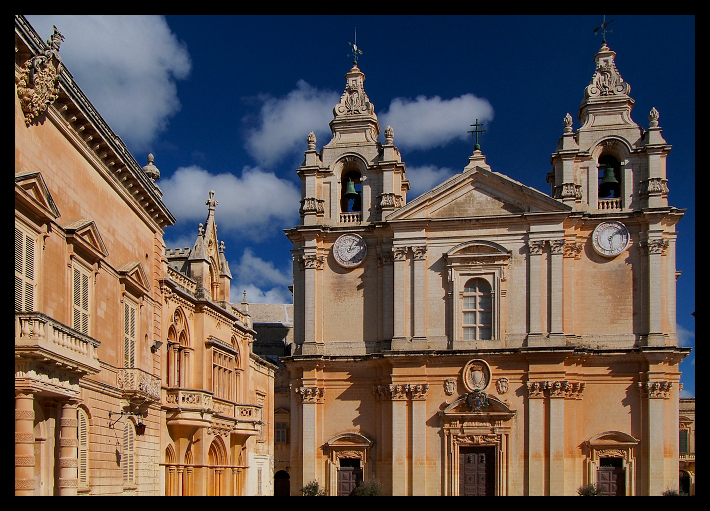
Mdina is known as the Silent City, and the name is well deserved. Its atmosphere is exceptionally calm.
While walking through its stone streets, one sees signs reminding visitors that Mdina is not merely a historic monument but a living town, and asking them not to disturb its residents with unnecessary noise.
The signs appear to be effective. Without them—or without the few people who still live behind these old walls—one might easily imagine oneself wandering through a film set.

The street above presents a typical Mdina scene: partly medieval, partly Arab and Middle Eastern, and unmistakably Mediterranean.
It is difficult not to be affected by the atmosphere while walking through these streets.
Here is another view from Mdina. Horse-drawn carriages move along what pass for its broader avenues, while the narrower streets belong mainly to pedestrians and bicycles.

Only the cars of local residents are permitted to enter the town. All other “modern” vehicles must remain outside the gates.
Returning to the coast gives us an opportunity to see a more contemporary Malta.
Saint Julian’s, north of Valletta, represents the modern face of the island. Familiar apartment buildings and commercial developments extend for kilometres along the shore.

The district contains not only holiday accommodation but also much of Malta’s business activity, particularly in finance and banking.
Even at the time of my visit, the inflow of foreign capital was clearly visible. Malta had managed to establish itself as an international financial centre while remaining within the regulatory framework of the European Union. The expensive cars on the roads offered their own less scientific evidence of economic prosperity.
At the far end of Saint Julian’s, the Portomaso marina complex presents its vision of an affluent modern lifestyle without excessive modesty.

During my visit, hotels were not especially expensive and could even be considered reasonably priced by the standards of popular Mediterranean destinations.
Eating and drinking, however, were among the genuine pleasures of the journey. The quality of the predominantly Mediterranean and Italian-influenced cuisine was consistently high, and restaurant presentation was unusually careful.
Malta proved to be a surprisingly rewarding destination for food. Restaurants served local wines, but many also offered a broad selection of French wines at very reasonable prices.
When our aircraft left Malta, it made a brief turn over the island. Looking down, I noticed the Rotunda of Mosta and pressed the shutter.
The church is famous for its enormous unsupported dome, one of the largest of its kind in Europe—a remarkable structure to find in a relatively small town on a small Mediterranean island.
Seen from above, Mosta and its Rotunda resemble a landscape from the Middle East or North Africa more than the conventional image of a European town.

I left Malta pleased to have experienced this beautiful island, shaped by so many histories and cultures at the centre of the Mediterranean.

No comments:
Post a Comment